
Ceres City Directory Collections
The Stanislaus County Library genealogy catalog is the main shelf map for Ceres city directory work. It lists early business and city directories, Polk’s Stanislaus County set, Haines North San Joaquin Valley criss-cross volumes, county telephone books, cemetery transcriptions, school directories, and other local finding aids. The collection table keeps the runs distinct. Some are physical, some are browsable online, and several have gaps that must be checked before a research trip.
| Collection | Years | Where held | Access |
|---|---|---|---|
| Early Stanislaus business and city directories | 1871 to 1891 | County Library genealogy collection | In-library town and business listings |
| Polk’s Stanislaus County directories | 1910 to 1991, with listed gaps | County Library | Alphabetic residents and varied street matter |
| Haines North San Joaquin Valley criss-cross | 1971 to 1990, with gaps | County Library | Address-first research in person |
| County telephone directories | 1966 to 1998; Modesto 1952 | County Library | Listed subscriber and address clues |
| Modesto city-directory microfilm | 1928 to 1933 | National Archives | Modesto title with regional coverage |
Ask the branch or the Modesto Special Collections Room to confirm shelf location, copying rules, database access, and reopening status. The Genealogical Society reported the Modesto collection secured during renovation with an expected summer 2026 reopening, so access should be verified before travel.
Ceres Under Modesto Titles
A major Ceres city directory quirk is the catalog title. R.L. Polk & Co. published Polk’s Modesto (Stanislaus County, California) City Directory, and catalog records expressly include Ceres, Oakdale, Hughson, Riverbank, and Salida. The larger market name can hide a useful Ceres entry. Search the county title, not only the town name.
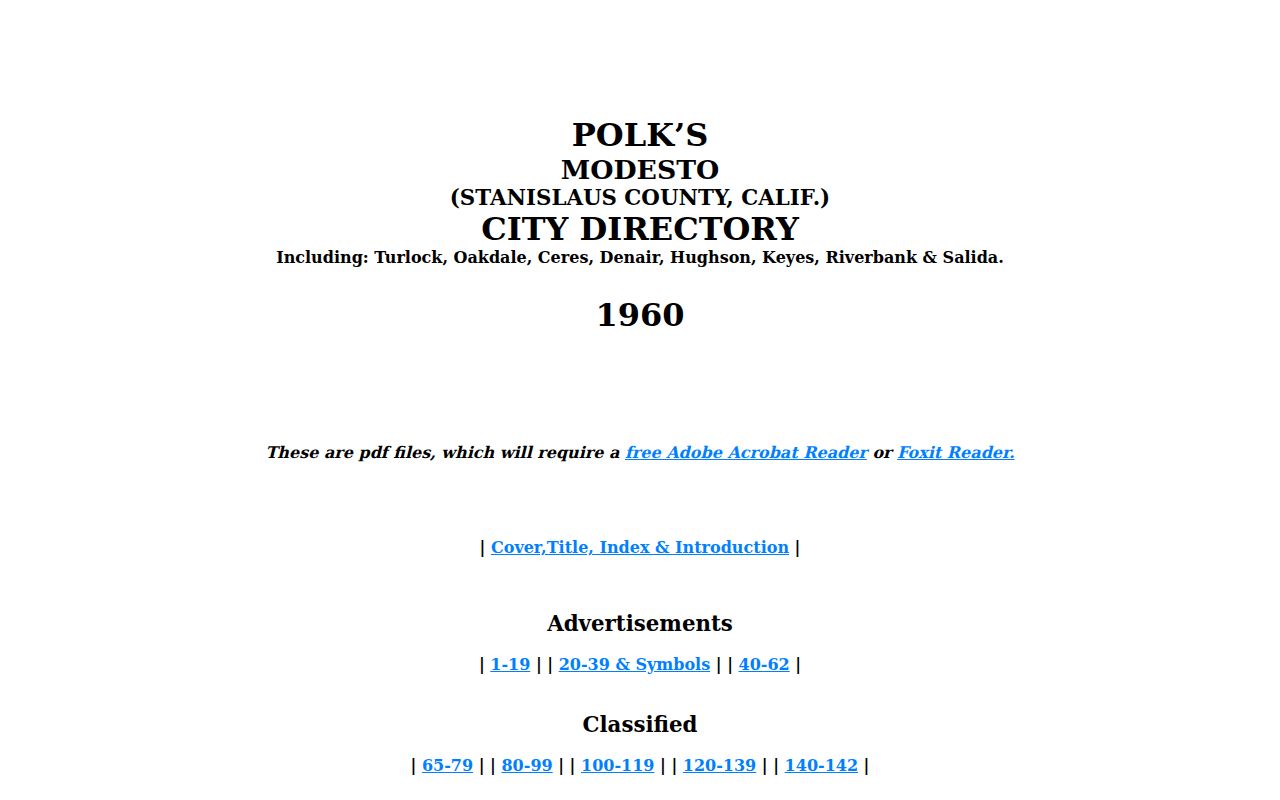
The freely browsable 1960 edition includes Ceres among Modesto, Turlock, Oakdale, Denair, Hughson, Keyes, Riverbank, and Salida. Its web index separates front matter, classified pages, alphabetic residents A to Z, and reverse guides for Modesto, Turlock, and Oakdale. It does not label a separate Ceres reverse section. That difference matters when a name search works but an address search does not.
The image below links to the 1960 Ceres-inclusive Polk directory. It shows a regional title whose Ceres entries must be found within the larger market.
FamilySearch also identifies a 1950 issue as physical or off-site, while reel guidance identifies Ceres-inclusive editions for 1956 to 1957, 1958 to 1959, and 1959 to 1960. An online catalog record is a holding clue, not a promise that a page image is open.
The FamilySearch city and business directory collection exposes a broad search form. Images may require an account or sign-in, so the fields below describe the search route rather than guaranteed Ceres page access.
| FamilySearch field | Available search choice |
|---|---|
| Name and life event | First name, last name, and Birth, Marriage, Residence, Death, or Any. |
| Place and years | Place, location, and year-from/year-to ranges. |
| Relationship clues | Spouse, father, mother, or other person. |
| Text and collection controls | Keyword, type, batch, film/DGS, principal, and exact-match controls. |
Polk’s Ceres Directory Years
Polk’s Stanislaus run spans 1910 to 1991, but the library catalog lists missing 1923, 1924, 1936, 1943 to 1945, 1947, 1949, 1951, 1955, and 1988. A missing volume should not be filled with a guess from the next year. Mark the gap, then use a telephone book, newspaper, census, tax or deed record, school directory, or another dated source.
Publisher format can change by year. Front matter may explain abbreviations, coverage, town names, or classifications. The alphabetic section can provide a name, spouse, address, occupation, business connection, and a notation such as h, r, or bds, but the exact meaning must be checked in that volume’s key. A directory entry is a time-stamped lead, not a continuous census.
Where a digitized volume is available, save the title page, page number, and abbreviation page with the entry. Where the volume is physical, record the call information supplied by the library and ask about copying before handling the book.
Early Ceres County Directories
The earliest listed Stanislaus business and city directories cover 1871 to 1891. They may emphasize merchants and town activity rather than every household. That makes them valuable for placing a family in a commercial or civic setting, but weak as a complete Ceres residents directory. The absence of a name can reflect the kind of book, not the absence of the person.
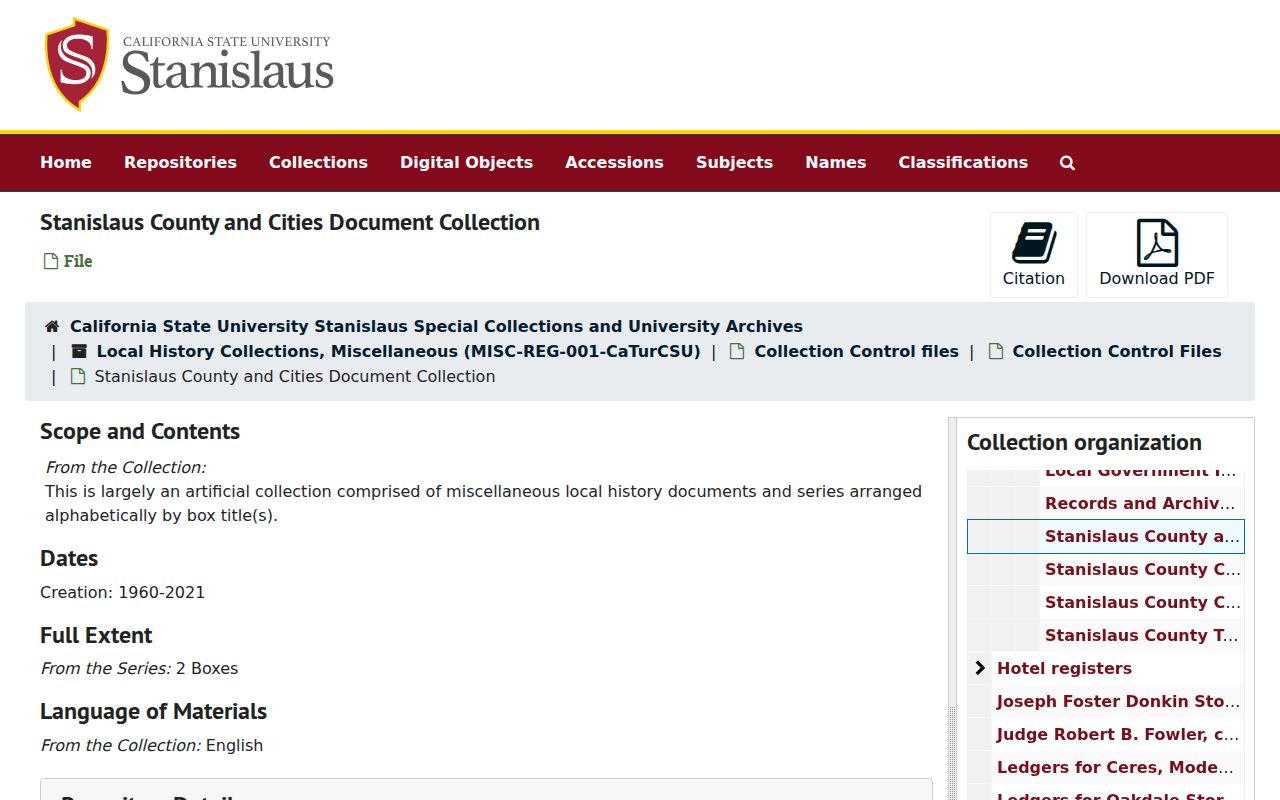
CSU Stanislaus Special Collections adds an unusually early source: an 1872 ledger for Ceres, Modesto, and Salida. Account headings, transaction dates, and place references may connect customers or merchants to the community before regular Polk volumes become the main path. The collection also holds 1884 to 1903 Donkin store ledgers. Names and transactions require inspection of the archival object rather than a claim that every entry is indexed online.
The ledger collection shown below is documented by CSU Stanislaus Special Collections. It gives Ceres family-history work a source older than the regular directory shelf.
Early local context also survives at the Ceres city history resource and the Ceres Historical Society and Whitmore Mansion, where photographs, school artifacts, early Ceres High yearbooks, business objects, and family-history material are held with appointment-dependent access. Contact the custodian before relying on a visit.
Stanislaus State describes its own Special Collections access as a route to regional books, manuscripts, oral histories, county documents, historic newspapers, and the Dias photograph collection. Exact title and year coverage still needs a catalog check.
Haines Criss-Cross for Ceres
Haines North San Joaquin Valley criss-cross directories cover 1971 to 1990, with catalog gaps including 1982, 1986, and 1987. They reverse the name-first order of a normal Ceres city directory. Start with a street and house number, then inspect the listed occupant or telephone subscriber. A reverse entry may reveal an address link when the surname spelling is uncertain.
The Haines run should be read beside Polk and telephone books, not treated as a replacement for either. A listed subscriber could have moved, shared a line, or remained in the book after leaving. Compare adjacent years and then check a deed, obituary, cemetery record, or census schedule for a second date.
- Criss-cross directory
- An address-ordered section that may list a name or subscriber after the street and number.
- Householder index
- A name-oriented finding aid for a household head or listed adult, depending on the publisher.
- Abbreviation key
- The volume’s guide to short marks. Photograph or transcribe it before reading entries.
- Listed subscriber
- A person attached to a telephone listing. It is not a guarantee of ownership or current residence.
Reading a Ceres City Directory Entry
Exact Ceres page images were not available for every run, so an entry should be checked against its own volume rather than copied from a generic example. A typical Polk-style line may place a surname and given name or initial first, followed by a spouse in parentheses, an occupation or business connection, a home address, and a short household mark. A widow notation can add a family clue. The fields below are an inventory of what to look for, not a claim that every year contains every field.
| Entry part | What to inspect |
|---|---|
| Name | Surname, given name, initials, spouse, and variant spelling. |
| Address | House number, street, town label, and any move from the prior year. |
| Household mark | h, r, bds, or another symbol defined by that volume’s key. |
| Business connection | Employer, business, or affiliation when printed by the publisher. |
| Page context | Classified, alphabetic, reverse, or front-matter section. |
Keep the original punctuation. Ceres families may appear with joined, spaced, or hyphenated surnames, and a second surname should not be assumed to be a middle name. A matching street plus a matching spouse is stronger than a shared first and last name alone.
Using Ceres City Directories for Family History
A Ceres city directory becomes useful when several editions are placed in order. Begin with the newest accessible year, work backward to the first appearance, and write down every address, spouse, business connection, and spelling. Then use the reverse section to test the address independently. The process is simple, but a missing volume or unlisted subscriber can look like a move unless the gap is marked.
- Find the earliest or latest accessible entry and copy its exact name, address, and page.
- Check adjacent editions for a move, spouse change, business change, or changed abbreviation.
- Use Haines or another reverse section to search the address without relying on the surname.
- Pair each directory period with the matching census or a dated deed, newspaper, cemetery, or probate clue.
- Record why the trail ends: missing year, move, death, unlisted subscription, or an unresolved spelling.
A directory that stops naming a household does not establish that every member left. Children may be omitted, many people were not listed, and the publication may skip a year. When a directory clue needs a current identity check, the Ceres resident lookup route can compare it with a modern custodian without turning the old entry into present-day proof.
Ceres Directories and the 1950 Census
The 1950 federal census is the latest census year available under the 72-year release rule at the time of this research. Pairing a Ceres city directory close to 1950 with the census can reveal a household relationship, an enumeration district, or a different spelling. The two sources have different collection rules: a directory may list a head or subscriber, while the census records the household as enumerated.
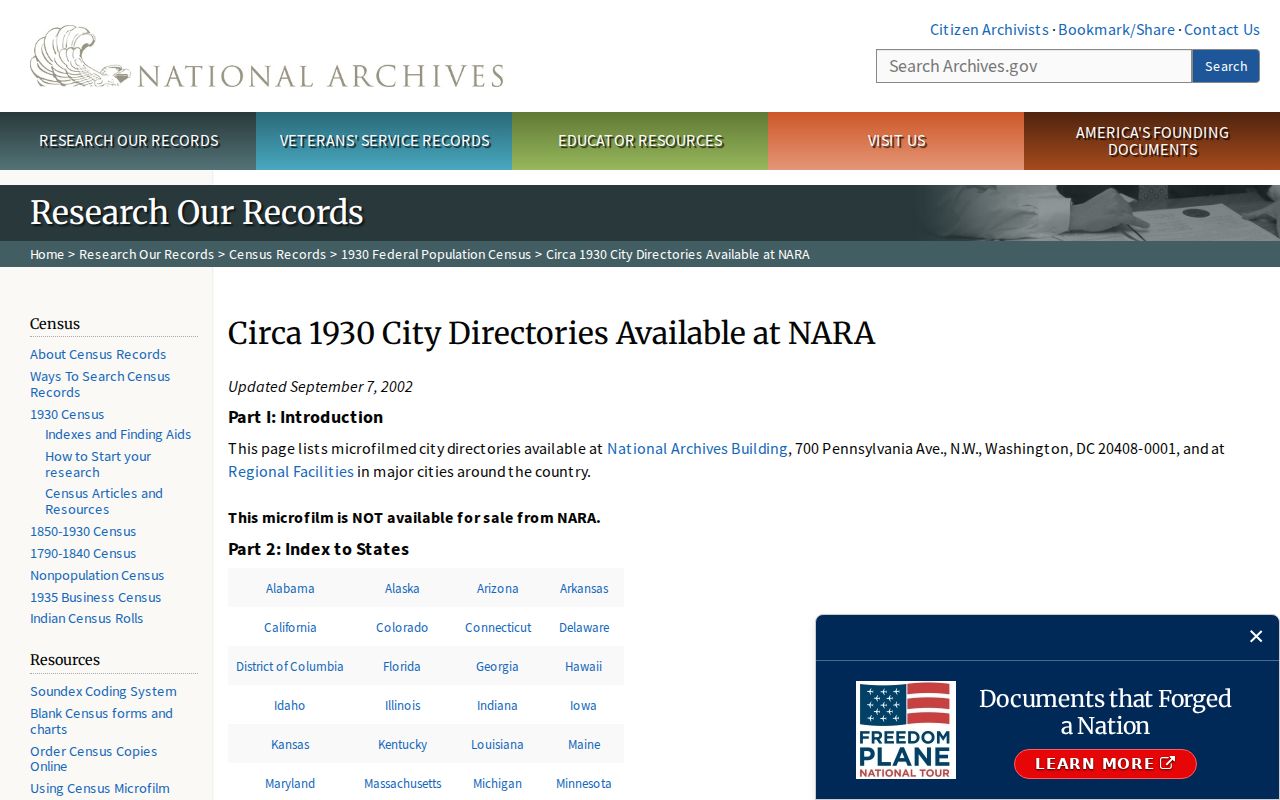
NARA’s directory table identifies Modesto including Stanislaus County and Turlock for 1928 to 1933. The image below comes from the National Archives directory holdings. It reinforces the regional catalog pattern that makes Ceres entries easy to miss.
Use the census to test a date, not to erase a directory discrepancy. A person can move between enumeration and publication, and a directory can use a business or mailing address. Record the source date and the type of address for every comparison.
Ceres Ledgers, Yearbooks, and Cemeteries
Directories are only one shelf in Ceres history. The County Library catalog lists cemetery transcriptions including Ceres Memorial Park, local periodicals, school directories grouped from 1944 to 1996, a Chamber organization run from 1955 to 1991, a burial-permit index from 1889 to 1948, and probate material from 1854 to 1917. These can bridge a missing volume year or explain why a name appears under a business or school context.
The Ceres Courier can lead to obituaries, school news, civic participation, and business history. McHenry Museum research resources in Modesto point researchers to Museum Monthly, StaniStory, and Stanislaus Stepping Stones, while Stanislaus State describes newspapers, oral histories, county documents, and a large Dias photograph collection. Use these for leads, then verify legal facts with the recorder, court, or vital-record custodian.
The Stanislaus State Special Collections account shown below documents a local-history access route for Ceres names, newspapers, oral histories, county records, and photographs. Confirm appointment and catalog coverage before relying on a specific year.
The collection is a finding route rather than a complete Ceres directory. Its value is the ability to connect a directory clue with a dated newspaper, ledger, manuscript, or photograph.
The McHenry Museum research route shown next adds a Modesto archive and publication trail to a Ceres historical-directory search.
McHenry’s publications can supply a name, date, or context lead, but the recorder, court, and vital-record custodians remain the controlling sources for legal facts.
A good historical trail names the collection, year, page or object, and access condition. It also says when a source is not online. The Library of Congress Ceres Sanborn catalog, for example, identifies two sheets created or published between December 1910 and June 1929 but says the item is unavailable online. A catalog record is not a downloadable image.
The Census QuickFacts entry for Ceres supplies demographic context only. It is not a resident list and should not be used to fill a missing directory year.