
Ceres Sources for Previous Residents
A Ceres previous residents search needs an era map before it needs more names. The recorder index reaches back to 1850, but image and retrieval methods change around 1978. The library’s directory shelf covers several twentieth-century runs with gaps. The census, permits, newspapers, probate files, and local collections answer still different questions. Use the table to choose a source that actually spans the date being tested.
| Source | Years it covers | Where held | What it shows |
|---|---|---|---|
| RecorderWorks index | 1850 to present; image workflow varies | Stanislaus Clerk-Recorder | Owners, parties, conveyances, liens, legal references |
| Polk’s Stanislaus directories | 1910 to 1991, catalog gaps | County Library | Named adults, address, occupation, business clues |
| Haines criss-cross | 1971 to 1990, catalog gaps | County Library | Address-first listed name or subscriber clues |
| Telephone directories | 1966 to 1998; Modesto 1952 | County Library | Listed subscriber and address |
| Federal census | Through 1950 under the release rule | Federal and genealogy collections | Household members, relationships, residence |
| City and archival files | Date depends on record | Ceres, CSU Stanislaus, local collections | Permits, ledgers, obituaries, school and civic clues |
The first step is not to promise a person. It is to write the address, APN, date range, and record question: title, occupancy, household, family, or building change.
Ceres APN Starting Point
Begin with today’s parcel when the research question is a house. The Ceres Street Address Locator can test city-limit ranges, while Stanislaus GIS can identify the polygon and APN. The assessor’s free web inquiry requires the APN in 000-000-000 form. It can then show assessment and address fields, including the distinction between situs and tax-bill mailing address.
A different mailing address can point to an owner’s correspondence location, but it does not prove that the owner lived at the property. Copy the APN, subdivision or legal reference, owner spelling, situs, mailing address, and the date viewed. Those fields let a later deed or map confirm that the same parcel is being followed.
For current address work, the Ceres street directory route explains the parcel bridge. A previous residents search then moves backward from that current anchor rather than guessing at an old surname.
Stanislaus Deed Chain Backward
The backward trail runs through RecorderWorks. The current owner usually appears as a grantee on the acquisition instrument. The earlier seller is the grantor. That grantor can then be searched as an earlier grantee, with the legal description or APN used to make sure the chain stays on the same land.
- Identify the current APN and owner through GIS, assessor, or a current tax reference.
- Search the owner in RecorderWorks as a grantee and note the recording date and document number.
- Copy the grantor, legal description, APN, book or page, and document type from the result.
- Search the grantor as an earlier grantee, then verify the same parcel rather than relying on the name alone.
- Repeat until the search reaches the desired period or the volume and page system requires office help.
The county’s recorded-document search instructions are shown in the capture below. The source is the official Stanislaus Clerk-Recorder deed research page.
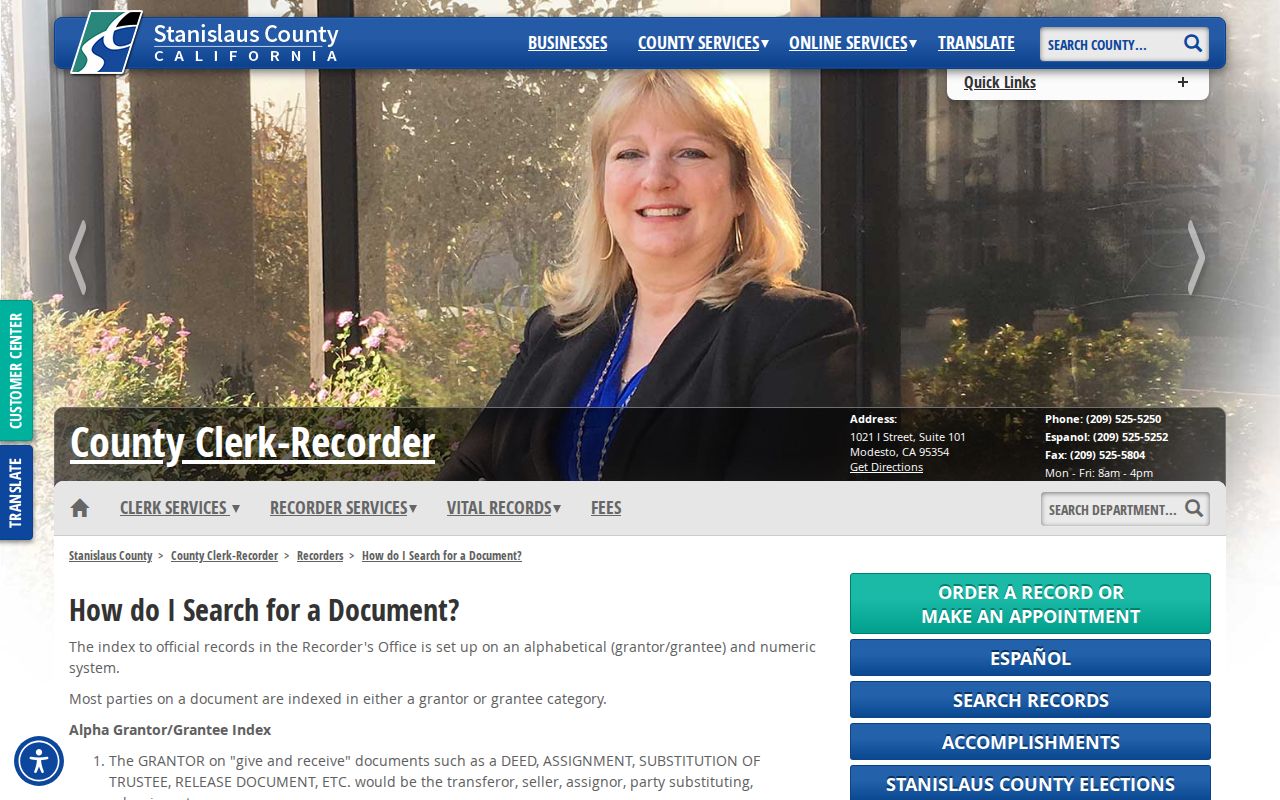
For a conveyance, grantor means seller or transferor and grantee means buyer or transferee. Encumbrances can use those labels for a debtor and creditor or another legal role. A party to a document is not necessarily an occupant.
- Chain of title
- The linked sequence of recorded transfers affecting one parcel.
- Grantor
- The party transferring an interest or appearing in the transferor role.
- Grantee
- The party receiving an interest or appearing in the transferee role.
- Legal description
- The formal land reference used to test whether two records concern the same parcel.
Ceres 1978 Image Cutover
The 1978 transition is an important Ceres previous residents research trap. Current office guidance describes computer-searchable indexes and images from 1978 forward. Earlier research may require the alphabetical grantor and grantee books plus a volume or book-and-page locator. RecorderWorks now advertises name-index metadata from 1850 to the present, but that does not mean every older image is delivered through the same online workflow.
The public index can still supply a name, document type, recording date, document number, and sometimes book or page. When the image is not available, order a copy through the office channel or ask for the older locator method. The county says the office terminal can show the index and image for the modern workflow, while copies are ordered at inside-office terminals.
The current Clerk-Recorder fee schedule is the source for the image below. It is linked through Stanislaus County recording and copy fees, where current amounts should be checked before a request is mailed.
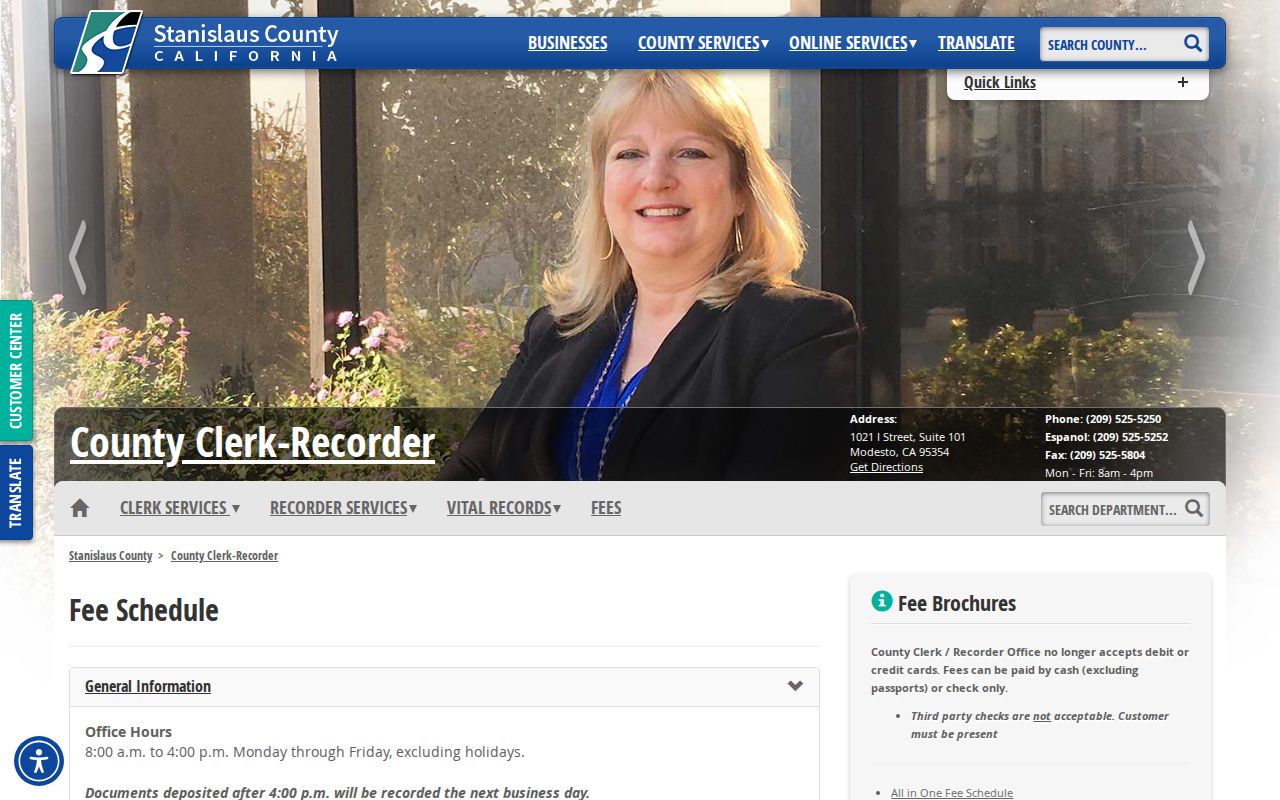
Recorded-document copies are currently listed at $6.75 for the first page, $3 for each additional page, and $2 for certification. The county also lists document-location research at $17 per 15 minutes and announced fee changes effective January 1, 2026. Verify the schedule at the time of the request.
Haines Reverse Search for Ceres
When a deed identifies an old date but not the people who used the house, check the Haines North San Joaquin Valley criss-cross run. The catalog lists 1971 to 1990, with missing 1982, 1986, and 1987 volumes. Search the street and number, record the listed name or subscriber, and compare adjacent editions. A reverse result can catch a surname spelling that a name-first search misses.
Polk’s Stanislaus County directories cover 1910 to 1991 with specific gaps. They are cataloged under the larger Modesto market and may list Ceres names, addresses, spouses, business ties, and short household marks. County telephone books run from 1966 to 1998. The directory shelf is described in the Ceres city directory collections route, while the previous residents question uses those volumes only as dated evidence for one address.
Directory absence is not proof that no one lived there. The volume may be missing, the person may be unlisted, or the publication may omit children and other household members.
Ceres Directories and 1950 Census
Pair a directory year with the nearest available census year to separate a change in household from a gap in publication. The 1950 federal census is the latest release point under the 72-year rule at the time of research. It can show household members, relationships, and residence as enumerated. A directory can show a listed adult, address, or subscriber. Those records should be read as complementary, not identical.
- Choose the directory year closest to the date being tested and copy the address and spelling.
- Check the nearby Polk, Haines, or telephone edition and mark any missing volume.
- Compare the address with the 1950 census or another dated household source.
- Use a deed, obituary, probate case, or newspaper to test a move, death, or heir link.
A Ceres previous residents trail is stronger when a household clue and a title clue meet at the same address and date. A census relationship does not change title, and a title record does not list every household member.
Ceres Permits, Probate, Obituaries
Building and planning files can date a physical change. Ceres Building Permits says submittals moved to electronic handling on July 1, 2024, and the county-hosted Accela lookup offers address, parcel, owner, record, and licensed-professional modes. No verified public permit-name database or exact permit-index start date was located. Ask Building for a narrow address and APN search when a project date matters.
| Accela search mode | Fields or use |
|---|---|
| Address | Street number from and to pair plus street name. |
| Parcel Information | Parcel or APN route for a known land record. |
| Owner and Record Information | Name or project-record routes when the corresponding detail is known. |
| Licensed Professional | Filing role search; a professional role does not prove residence. |
Probate and obituary records can close a previous-resident trail when a deed stops at a deceased owner. Stanislaus Superior Court’s family and probate request form asks for one case, case type, party names, filing or judgment years, requested document, requester details, and a mailing route. The county library has cemetery transcriptions, including Ceres Memorial Park. The Ceres Courier and local collections can supply obituary or family-history leads.
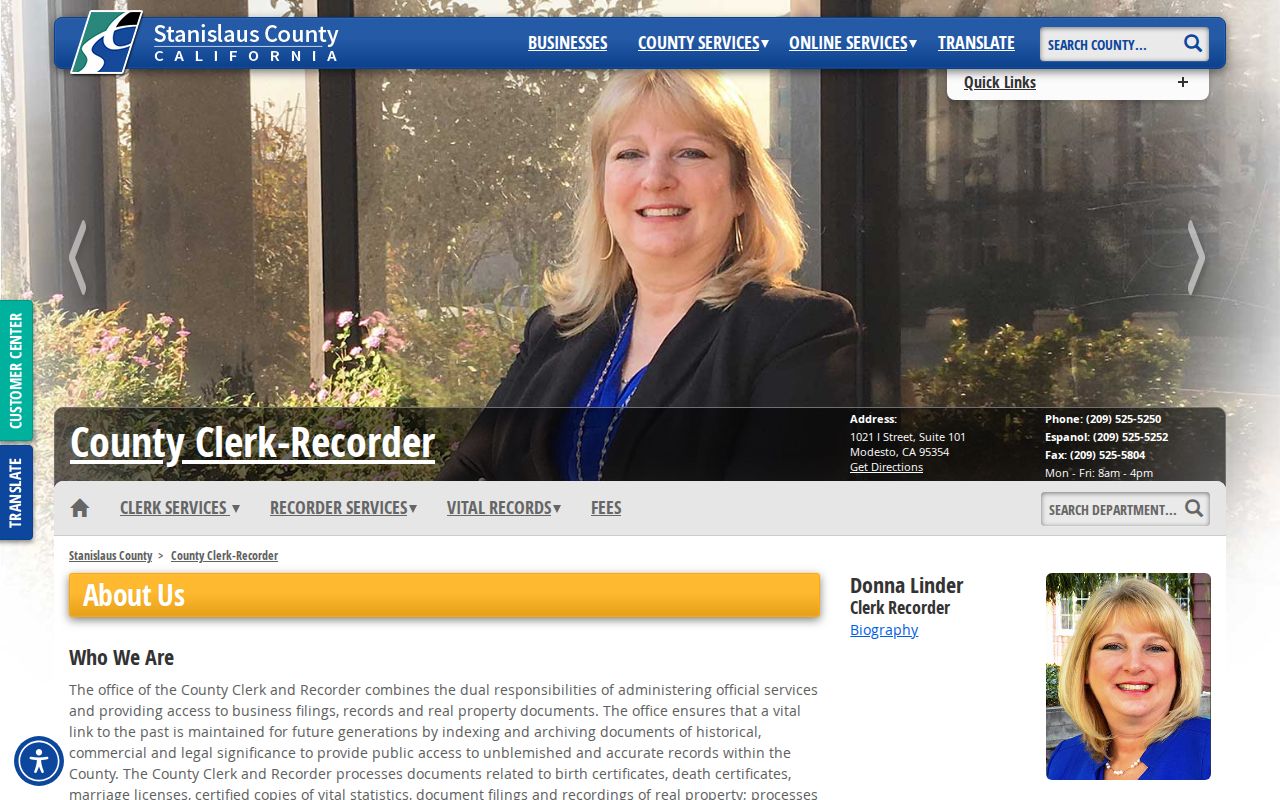
The county’s Clerk-Recorder services page is the starting point for current counter, mail, deed, and vital-record routes. The county birth and death copy application shows the requester, registrant, date, place, relationship, certificate, and sworn-statement fields. A certificate request is separate from a deed-chain search.
The public Clerk-Recorder services page below is the source for the third image. It links the deed, vital, and copy channels needed when an online index ends.
Use probate to connect a person to an estate or heir question, not to assume that every heir lived at the parcel. Confirm the legal and family link in the court or vital record when access allows.
Ceres Past Households and Lawful Use
Previous residents can be owners, listed adults, subscribers, household members, or people named in a local record. Those categories overlap, but they are not interchangeable. A property chain tells who held an interest. A directory can show who was listed. A census or obituary can add a family clue. A permit can show who filed or owned during a project. Write the category beside every name.
Ceres has a rich local-history layer around the Whitmore family, the 1872 Ceres, Modesto, and Salida ledger, early Ceres High yearbooks, cemetery transcriptions, newspaper files, and the Whitmore Mansion museum at 2928 Fifth Street. These sources can explain a past household without claiming that a living person can be located through them. Check appointment and access conditions before relying on a collection visit.
California’s Safe at Home program shields eligible participants with a substitute mailing address. Court, vital, voter, and recorder records have their own restrictions. Correct an error with its custodian, and keep a date on every historical result.
House-history use. Previous residents research is appropriate for a documented house, family, estate, or community question. Do not use a past address or living person’s record to stalk, harass, threaten, or intimidate anyone.